The newly launched meat-processing complex specializing in chilled lamb, LLP Batys Marka Lamb, has moved into full operation this year in West Kazakhstan Region and has begun forming its first export batch. Currently, the enterprise is operating at 60% of its design capacity. During a press tour, the head of the regional branch of KazAgroFinance JSC, Tulebai Mendorazov, noted that the project was financed by the company at 85%, with investments amounting to about 2.2 billion tenge. The complex is equipped with machinery from the Italian company Rovani SrL, enabling a fully automated production cycle—from slaughter and deboning to deep freezing and packaging.
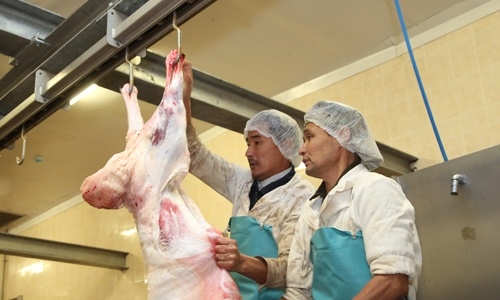
The director of LLP Batys Marka Lamb, Bakhytzhan Keskimbaev, explained that from March to September the enterprise worked in test mode, fine-tuning 12 production units and training local personnel. During this period, daily slaughter volumes increased from 30 to 500 heads per shift. By the end of the year, production is expected to reach 700 heads per shift. The plant has already created 80 jobs, and once full capacity is achieved and exports to Russia expand, the workforce will grow to 150 employees.
The enterprise is primarily export-oriented (around 80% of production), focusing on the major Russian markets of Moscow and St. Petersburg. On the domestic Kazakhstani market, 4.5 tonnes of meat have already been sold under the “MARKA Lamb” brand.
At present, the company is preparing an export batch for Uzbekistan, having signed a long-term contract for supplying 100–150 tonnes of lamb per month.
Exports of chilled lamb to Russia are expected to begin before the end of the year, once all related regulatory issues are resolved at the government level.
Currently, livestock is supplied by only one farm—LLP Bіrlik Mal Zauyty from the neighboring Zhangaly district, but in the future the plant plans to source sheep from five surrounding districts, which together account for more than 60% of the region’s total sheep population.
According to the head of Bіrlik Mal Zauyty, Kanat Yeshimov, the establishment of the new complex in Akzhaik district is highly advantageous for local farmers: they no longer need to transport livestock to other regions for lower prices, and the state provides a subsidy of 100 tenge per kilogram of net meat. His farm keeps 12,500 sheep, and this year he has supplied around 1,600 head to Batys Marka Lamb, planning to increase deliveries to 3,500–4,000 annually.
The plant accepts sheep weighing no less than 25 kilograms live weight and maintains strict quality control at all stages of production to meet international market requirements.
Development of a comprehensive automation solution is the creation of a unified, integrated control system that combines software and hardware to automate all key business and production processes of an enterprise. Such a system provides centralized management, resource optimization, increased productivity and product quality, as well as reduced costs and workforce requirements.
Development of a comprehensive automation solution
Centralized control of processes across the entire production facility
Manufacture and installation of control panels, including power and control sections
Staff training and subsequent system maintenance